The Last Lines Belonged to Her

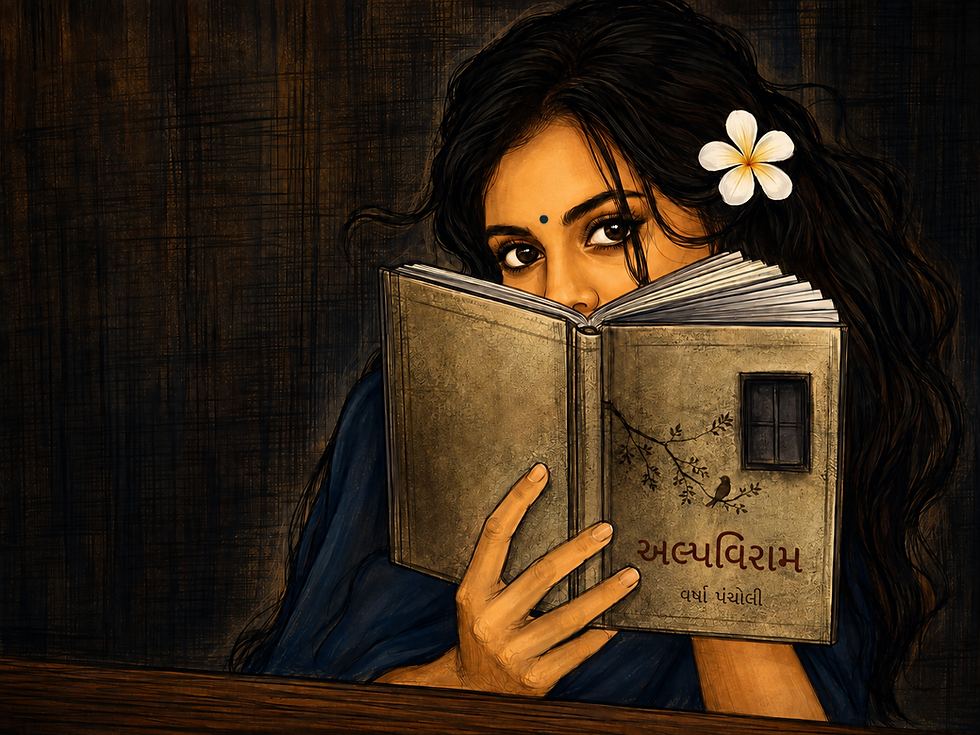
What my mother’s fifty-year-old Gujarati poems taught me about AI, originality, and the strange new value of being human.
AI is everywhere.
AI is taking jobs. AI is creating jobs. AI will replace writers. AI will replace designers. AI will replace programmers, teachers, consultants, filmmakers, musicians, accountants, perhaps half the office and eventually the other half. Every morning seems to arrive carrying another prediction about artificial intelligence, followed by another demonstration of something it can now do that, until recently, required a reasonably skilled human being.
After more than two years of using AI almost every day, I no longer find most of these demonstrations particularly surprising.
Of course AI can do the work.
That argument, I think, is already over.
It can prepare a business plan, analyse a market, build a presentation, summarise three hundred pages, generate twenty campaign directions, produce a reasonable photograph of a person who never existed, write code, rewrite code, design a logo, translate a document, construct financial scenarios and draft in thirty seconds what might once have occupied an afternoon.
Sometimes it does these things badly. Increasingly, it does many of them rather well.
And there is something slightly uncomfortable about admitting this when you belong to that broad tribe of people who have always enjoyed making things.
For years, the pleasure was in the making.
The empty page mattered. So did the unnecessary sketch that eventually became the right sketch, the sentence deleted eleven times, the rejected headline, the strange idea scribbled at two in the morning, the colour combination that made no sense until suddenly it did. A large part of creative work was wandering around without knowing precisely where you were going.
Now much of that wandering can be outsourced.
The blank page has become a prompt box.
What once involved hours of wrestling with an idea can become: Give me twenty concepts. Make option seven stronger. More cinematic. Less conventional. Try again.
Creation begins to resemble supervision.
It is extraordinarily efficient.
It is also, sometimes, extraordinarily boring.
There are days when I close an AI window having accomplished more than I could once have achieved in several days and yet feel strangely less satisfied. The output is there. The work is finished. But something that used to happen between the beginning and the end has disappeared.
The struggle, perhaps.
Or discovery.
Or that little neurological reward of finding something that did not exist before you found it.
AI has not killed creativity. That would be a ridiculous claim.
But it has changed the emotional architecture of creative work.
Sometimes it feels almost vampiric: feeding us the small dopamine rewards of instant completion while quietly draining away the deeper satisfaction that came from wrestling with uncertainty long enough to produce something of our own.
And then there is the much larger problem.
Everyone has the same vampire.
The Economics of Sameness
Democratising creative tools is, in principle, a wonderful thing.
A person who cannot afford a designer can now create a respectable poster. A small business can prepare a presentation without an agency. Someone uncomfortable with English can communicate professionally. A student can understand a difficult concept. A first-time entrepreneur can interrogate a business model before losing money on it.
These are not minor achievements.
The problem begins somewhere after democratisation.
It begins when accessibility is mistaken for originality.
Open LinkedIn, Instagram, a startup website or almost any content platform today and the strange sameness becomes difficult to ignore. Similar strategies. Similar captions. Similar layouts. Similar colour palettes. Similar startup vocabulary. Similar “thought leadership.” Similar cinematic photographs. Similar inspirational sentences delivered with similar confidence.
We were always copying one another, of course. Human beings invented imitation long before artificial intelligence.
AI simply industrialised it.
The problem is not uniquely Indian, although it is particularly visible in markets like ours where scale and speed have often been rewarded more generously than experimentation. Give imitation a machine capable of producing ten variations in ten seconds and the copycat no longer needs to be particularly talented. He only needs access.
The result is an extraordinary increase in supply.
More designs.
More articles.
More agencies.
More consultants.
More “brands.”
More content than any civilisation has ever produced, most of it arriving faster than anyone could possibly consume it.
And something predictable happens whenever supply explodes.
Prices fall.
If almost anyone can produce a competent logo, competent presentation, competent photograph or competent five-hundred-word article, then competence itself stops being scarce.
That frightened me initially.
Now I suspect something more interesting is happening.
While AI is making production cheaper, it may simultaneously be making originality more expensive.
Because once everybody can make something, the important question changes.
It is no longer:
Can you make this?
It becomes:
Is there anything in what you made that could only have come from you?
That is a much harder question.
And AI has forced creative people to confront it.
The Machine Can Write. But Whose Life Is It Writing?
My own relationship with AI becomes clearest when I write.
I use it constantly for professional work. Give it information, context, constraints and data and it can be extremely useful. Business plans, market structures, pitch decks, research, comparisons, calculations, frameworks. These are precisely the kinds of tasks where machines can save enormous amounts of time.
But stories have been different.
Not content.
Stories.
Stories we have lived.
Stories we have imagined for years before writing the first sentence.
Stories overheard at family tables.
Stories inherited from grandparents.
Stories born from guilt, embarrassment, grief, desire, fear and those peculiar memories we carry for decades without understanding why they survived when thousands of apparently more important moments disappeared.
I have asked AI to help with such writing many times.
I have given it context. Character histories. Emotional histories. Detailed instructions about rhythm, psychology, chronology, atmosphere and literary style. I have rewritten prompts, expanded prompts, argued with prompts, corrected the output and explained precisely what was missing.
It frequently gives me perfectly respectable prose.
That is the problem.
It is respectable.
The grammar is there. The metaphor is there. The emotion is technically where emotion should be. A grieving character behaves recognisably like a grieving character. A frightening scene contains the appropriate darkness. A childhood memory arrives carrying the expected nostalgia.
Everything is correct.
And something is dead.
AI knows an astonishing amount about the language of grief.
It does not know your grief.
It knows how thousands of writers have described mothers.
It does not know how your mother folded a particular piece of paper, which Gujarati word she preferred when she was angry, what she said from another room, which sentence she never finished, or why a completely ordinary medical bill might become precious half a century later simply because her handwriting exists on its reverse side.
Those differences once seemed sentimental.
I am beginning to think they may become economically important.
Because they cannot be manufactured at scale.
Then, recently, I read about something called Project Panama.
The name sounds almost fictional.
It was not.
Documents disclosed through litigation concerning Anthropic, the company behind Claude, revealed an internal project involving the acquisition and destructive scanning of physical books. Books were purchased in large quantities, bindings were removed for industrial scanning, and the resulting material became part of the company's digital corpus. An internal document described Project Panama as an effort to “destructively scan all the books in the world.”
There are complicated legal questions surrounding AI training, copyright, fair use and the distinction between lawfully purchased material and pirated copies. A federal court held, among other things, that Anthropic's conversion of purchased print books into digital copies for its central library was fair use, while treating its acquisition of millions of books from pirate libraries differently.
But the legal argument was not what stayed with me.
The symbolism did.
Why books?
With almost the entire internet available, why would one of the most sophisticated AI companies in the world need mountains of old physical books?
The reporting offers part of the answer. Anthropic's own internal thinking recognised the value of books as sources of carefully developed language, coherent reasoning and compelling long-form narrative. The very qualities that an internet increasingly polluted by low-quality and AI-generated text cannot reliably supply.
There is a magnificent irony in that.
We are being told that machines may make writers unnecessary.
Meanwhile, machines are being fed the work of writers because human beings apparently spent centuries producing something the machines still need.
Books.
Human sentences.
Human observations.
Human imagination.
Human lives compressed into language.
And that thought led me somewhere completely unexpected.
It led me to my mother.
The Papers
My mother died leaving behind more than memories.
She left poems.
More than a hundred Gujarati poems, written roughly fifty years ago.
Not preserved in leather-bound journals.
Not catalogued.
Not typed.
Not stored safely in the cloud.
They survive on the kinds of things ordinary people write on when they are not thinking about history.
Old notebook pages.
Loose sheets of paper.
Yellowing scraps.
The back of a medical bill.
Some are pale with age. Some have torn edges. Some carry folds that have probably been opened and closed hundreds of times. Time has eaten portions of a few pages. Words disappear where paper has disappeared.
There are poems about happiness.
There is pain.
There is longing.
There are emotions I recognise and others that make me wonder who my mother was before I knew her as my mother.
That may be one of adulthood's strangest discoveries: realising that our parents had entire interior lives before we entered them.
A woman who later became “Mummy” once sat somewhere with a pen and wrote a poem because something inside her demanded language.
No algorithm suggested a metaphor.
No machine generated alternatives.
Nobody asked whether the opening line had enough engagement potential.
She simply had something to say.
And she said it.
A few of those poems are incomplete.
Not artistically incomplete.
Physically incomplete.
The paper has torn away and taken the ending with it.
At first this felt like a problem modern technology should easily solve.
After all, here was exactly the sort of task AI is supposed to be brilliant at. Gujarati language. Existing poem. Established emotional context. Established vocabulary. Established rhythm. All I needed were one or two missing lines.
So I gave one of the poems to AI.
I explained the context.
I asked it to study the language.
I asked it to understand the emotion.
I asked for an ending.
It gave me one.
Wrong.
I tried again.
Wrong.
I explained more.
Again.
Different model.
Different instruction.
Another attempt.
Then another.
Hours passed.
The first day disappeared.
The second day began.
AI kept producing lines.
Some were grammatically good. Some were poetic enough. Some rhymed. Some sounded exactly like the sort of ending one might expect from a Gujarati poem written in that period.
But none sounded like her.
That distinction is almost impossible to explain to a machine because I could barely explain it to myself.
There was no measurable error.
No factual mistake.
No obvious grammatical failure.
The words simply did not belong to my mother.
And suddenly I understood the problem.
AI was trying to complete a poem.
I was trying to hear a woman who was no longer there.
Those are not the same task.
The missing lines were not a language problem.
They were a life problem.
To reconstruct them properly, one would need more than Gujarati vocabulary and poetic patterns. One would need to know what she had experienced before writing the poem. What she believed. What she feared. What she had lost. What had happened that morning. Who had disappointed her. Whether she was hopeful when she began the poem and angry when she ended it. What memories certain words carried for her that they carry for nobody else.
A language model can infer patterns from millions of lives.
It cannot go back and live one.
My mother's handwritten poem beat artificial intelligence.
Not because she possessed a larger vocabulary.
Not because she had access to more information.
Not because she could process language faster.
She possessed the one dataset AI could never download.
Herself.
Perhaps We Have Been Asking the Wrong Question
For the past several years we have been obsessed with one question:
What will AI replace?
It is an understandable question, particularly if your livelihood depends upon something a machine has suddenly learned to do.
But I am beginning to think there is a more useful question.
What becomes more valuable because AI exists?
When calculation became cheap, judgement became more important.
When photography became ubiquitous, merely owning a camera stopped making someone a photographer.
When publishing became almost frictionless, publishing itself stopped proving that something deserved to be read.
AI may produce a similar shift on a scale we have never experienced.
Average execution will become almost free.
Polish will become abundant.
Competence will be available on demand.
Which means the premium will move somewhere else.
Taste.
Point of view.
Judgement.
Memory.
Experience.
Cultural intimacy.
Unfashionable obsessions.
Contradictions.
The courage to make something that a predictive system would never predict because no previous pattern quite justifies it.
In other words, the advantage may return to the genuinely creative person.
Not immediately. There will be an enormous amount of noise first. There already is.
But the economics are difficult to escape.
When imitation becomes infinite, originality becomes scarce.
And scarcity creates value.
This is why I no longer believe creative people should spend their energy trying to outrun AI at what AI does best.
We will lose that race.
It works faster.
It does not sleep.
It does not become bored.
It does not stare at the ceiling at three in the morning wondering whether paragraph seventeen ruined the entire chapter.
Let the machine have speed.
Let it have variations.
Let it have summaries and formatting and first drafts and calculations and all the other things it can do spectacularly well.
Our task is different.
We have to become more human, not less.
We have to pay closer attention to the particular.
We have to remember things machines cannot remember for us because they happened before anyone thought they mattered.
We have to notice the phrase our grandmother used only when she was frightened.
The smell of the first house we lived in.
The silence after a particular argument.
The lie somebody told thirty years ago.
The road that no longer exists.
The family story whose details change depending on who tells it.
The love that embarrassed us.
The mistake we still defend.
The things we buried.
The things that refused to remain buried.
That is where human creative advantage may survive.
Perhaps even flourish.
AI can study every description of rain ever published.
Only you stood in that rain.
AI can analyse a million poems about mothers.
Only you had your mother.
AI can generate ten thousand sentences describing loss.
Only you know the exact shape of the empty chair.
That difference once seemed too small to matter.
Soon it may be everything.
I still have my mother's incomplete poems.
The temptation remains to finish them. Technology will improve. Models will become better. Perhaps one day an AI will generate a final couplet so beautiful that I will stare at it and wonder whether she herself might have written it.
But even then there will be a problem.
Might have is not did.
Beautiful is not the same as true.
And perhaps those poems should remain exactly as time has left them: handwritten, yellowing, damaged and occasionally unfinished.
The torn edge is part of the manuscript now.
The absence is part of the poem.
Because the missing words tell me something too.
They remind me that there was once a woman sitting somewhere with a piece of paper, feeling something deeply enough to write it down.
A machine can continue her sentence.
It can imitate her vocabulary.
It can study the structure.
It can propose an ending.
But it cannot return to that room.
It cannot become that woman.
It cannot live the life that would have produced the missing line.
And after two years of worrying about everything artificial intelligence might take away from creative people, a torn piece of fifty-year-old paper finally showed me what remains.
The future of creativity may not belong to those who can produce the most.
It may belong to those who have something the machine cannot manufacture.
A memory.
A wound.
A peculiar way of seeing.
A life.
My mother's poem is still unfinished.
I think I finally understand why it should remain that way.
Sometimes the missing words are the strongest evidence that a human being was there.


